· FastFlow Team · 6 min read
You don't need another AI chatbot. You need AI that works.
AI that chats is everywhere. AI that actually works for you? Almost no tool can do that.
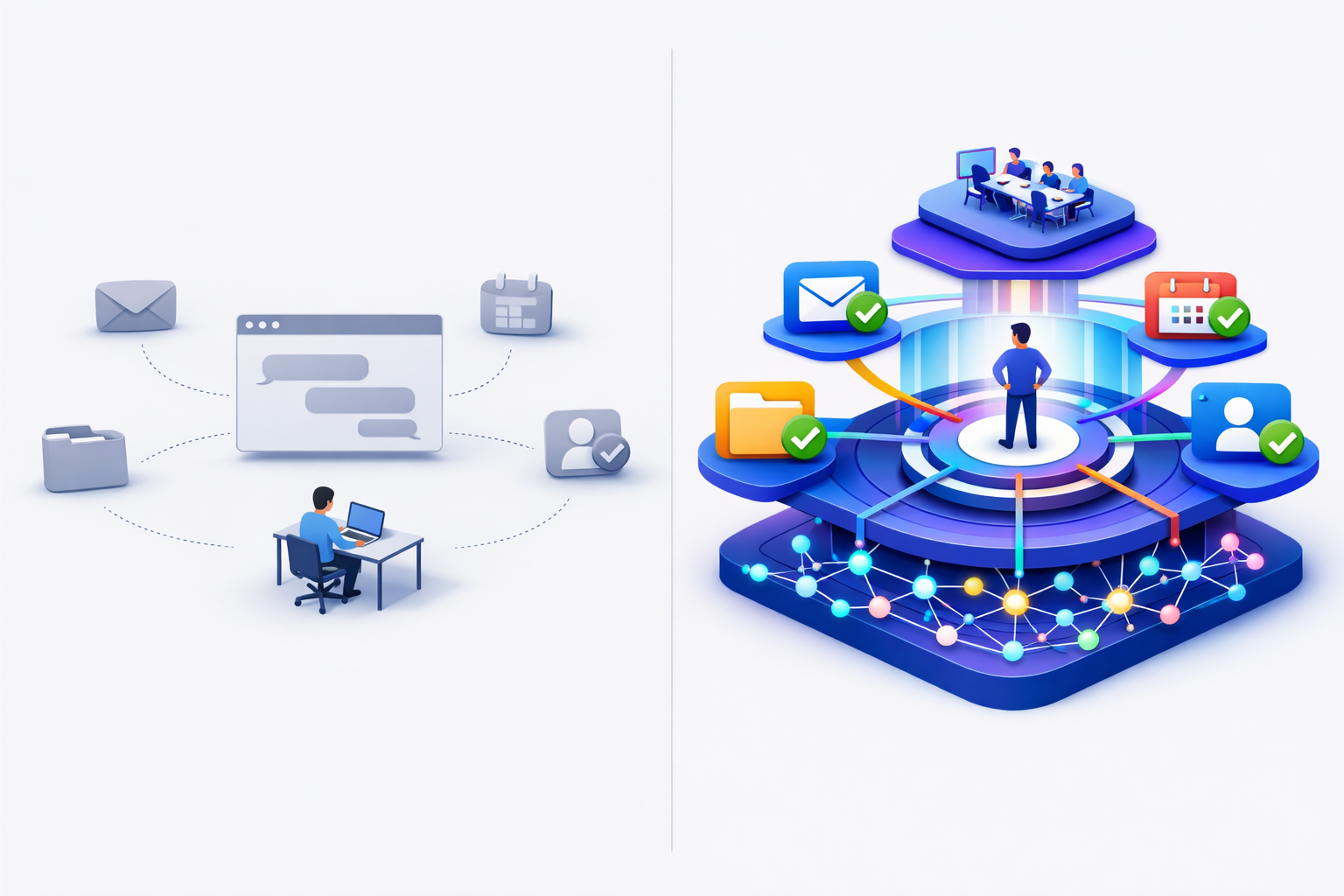
Want to chat with AI? You already have options
ChatGPT, Claude, Gemini, Grok — they’re all great. If you want to ask a question, brainstorm an idea, or draft a paragraph, any of them will do.
But if you want AI to actually work for you? To send that email, pull data from your calendar, remember what you told a client six months ago, and share that knowledge with your team? That’s a completely different problem.
And none of those tools solve it easily.
The 10% problem
AI is simultaneously overhyped and underused. On one side, people tell you AI will replace every job. On the other, most people use it to rephrase emails and generate birthday messages. The reality is somewhere in between, and almost nobody’s found it.
Even power users tap into maybe 10% of what AI can actually do. And that’s not their fault. There are courses, certifications, “prompt engineering” guides, YouTube tutorials. You’re told you need to become an expert just to use a tool properly. That’s a design failure, not a user failure.
The tools are designed for chatting, not working. You type a question, you get an answer, you copy-paste it somewhere else, and you move on. That’s the entire workflow. It’s like having a brilliant consultant who can only communicate through sticky notes.
The gap between what AI could do for your work and what it actually does is enormous. Not because the AI isn’t capable, but because the tools around it aren’t built for real work.
The tools problem
AI becomes genuinely powerful when it can act: send emails, check calendars, search documents, update databases. The technology for this exists. It’s called MCP (Model Context Protocol), and it lets AI connect to your tools.
The catch? Setting it up requires you to be basically a developer. API keys, server configurations, JSON schemas, OAuth flows. Even IT professionals struggle with this stuff.
So what happens? AI stays in a chat window. It can tell you what to do, but it can’t do it. You end up as the bridge between AI’s suggestions and your actual tools.
The memory problem
Think about this: what separates your AI experience from anyone else’s? Just one thing — context.
The same AI model answers a college student and a 20-year industry veteran. The difference in value comes entirely from the context you provide. Your projects, your clients, your company’s processes, your preferences.
Current AI tools are starting to offer memory — they can note things from your conversations. But it’s clumsy. Your dream car suddenly comes up when you’re asking about a math problem. You either tell the AI to stop doing that, or you opt out of memory entirely. There’s no way to organize what’s remembered by project or client.
Who remembers the details of what you discussed with Client A three years ago? Who remembers your company’s specific process for handling returns? Who remembers that your team lead prefers bullet points over paragraphs?
Not your AI. Not reliably. Not in a way you can control.
The sharing problem
Let’s say you’ve actually built something great with AI. A workflow, a knowledge base, a set of prompts that work well for your job.
How do you share that with your team?
Copy-paste a prompt? Send a screenshot? Write a guide that’ll be outdated next week?
Current AI tools are single-player experiences. Your context stays locked in your account. Your team can’t build on what you’ve learned. Your company can’t leverage AI knowledge across departments.
Every person in your organization starts from zero. Always.
What FastFlow does differently
We built FastFlow because we hit every single one of these problems ourselves. Here’s how we think about solving them:
AI that acts
One-click service connections. Gmail, Calendar, Google Drive — you click “Connect,” authorize it like any app, and it works. No API keys. No configuration files. No coding.
Say “send a follow-up email to John about yesterday’s meeting” and it actually sends the email. Say “browse the current economic news, cross-reference it with my sales data from last month and Google Trends, predict next quarter’s outlook, brainstorm a strategy to grow revenue and cut costs, then send the report to my manager” — and it does all of that across multiple tools in one go. AI that does things, not just talks about them.
The best AI for every task
Why lock yourself into one AI? ChatGPT writes well. Claude thinks deeply. Gemini generates images. Grok creates videos. Each has strengths.
FastFlow lets you use all of them. Plan a project with Claude, draft the blog post with ChatGPT, generate the cover image with Gemini, create a promo video with Grok. Switch between models in the same workspace, same conversation. No separate subscriptions, no switching tabs, no starting over.
You always get the best AI for the job. Not the one you happen to be paying for.
AI that remembers, on your terms
A knowledge graph you can actually see and control. Not a hidden memory system that may or may not remember the right things.
You decide what’s stored. You can correct what’s wrong. You can remove what’s outdated. Knowledge is scoped. Personal stays personal, team knowledge stays with the team, company knowledge is shared across the org.
The longer you use it, the better it gets. But you stay in control of what it knows.
AI that’s actually accessible
You shouldn’t need a course to use AI well. You shouldn’t need to learn prompt engineering or understand what “temperature” and “tokens” mean.
FastFlow makes you effective with AI without making you an expert first. We handle the complexity so you focus on what you want done, not how to ask for it.
Workspaces that make sense
Personal workspace for your own productivity. Team workspaces for collaboration. Company workspaces for organizational knowledge.
The right context, at the right level, with the right access controls. Your personal notes don’t leak to the company. Company processes are available to everyone who needs them.
The real competition
Here’s the thing people get wrong about AI: you’re not competing against AI. You’re competing against people who use AI efficiently.
The person who figures out how to make AI actually work for them — not just chat, but work — has an overwhelming advantage. They move faster, remember more, and never start from zero every time they work with AI.
You won’t lose to AI. You’ll lose to the one who uses it well. FastFlow makes you that one.